
Church Financing Guidelines for Church Boards
A practical guide for pastors, treasurers, finance committees, and church boards evaluating church loans, refinancing, construction, renovation, or property purchase decisions.
These church financing guidelines are drawn from Griffin’s 2026 survey of 113 U.S. churches and 26 years of church lending experience. The goal is not to push a church toward borrowing. The goal is to help boards decide with clarity, stewardship, and long-term financial discipline.
Updated June 2026. This guide is designed for pastors, treasurers, finance committees, and church boards reviewing financing decisions.
For board discussion, Griffin has also prepared a downloadable Church Financing Guidelines Checklist for Church Boards that summarizes the key readiness questions in a printable format.
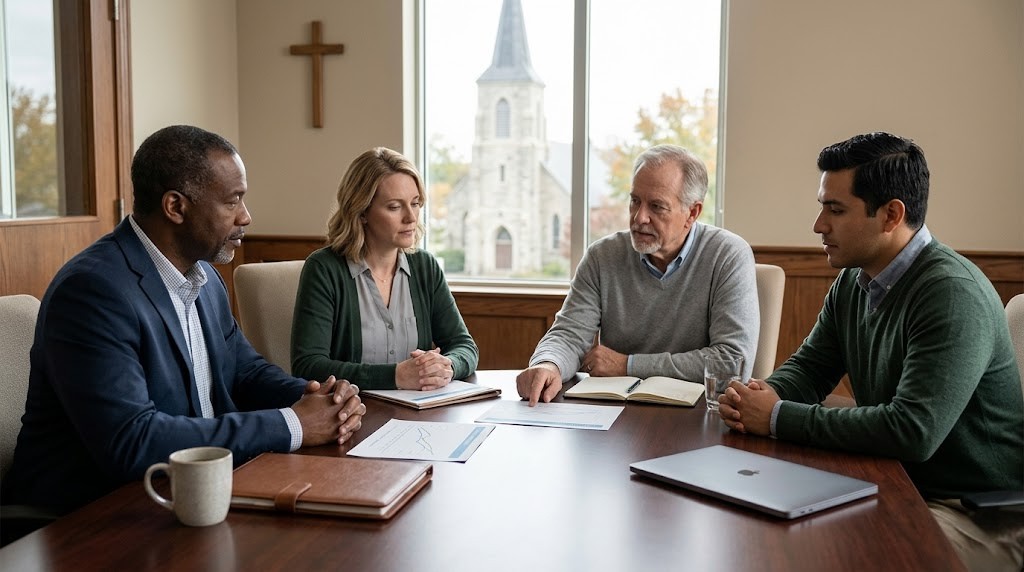
Church Financing Guidelines: What Every Board Should Confirm First
Before a church moves forward with borrowing, refinancing, renovating, or purchasing property, the board should make sure the decision is clear, affordable, and aligned with the ministry’s long-term mission. This framework is designed to help church boards and finance committees evaluate major financing decisions with more confidence and better stewardship.
Before moving forward, confirm these five points:
Church Financing Guidelines: What Every Board Should Confirm First
A disciplined church financing decision is not just about loan approval. It is about stewardship, sustainability, and clarity. Before moving forward, every board should review the following areas.
| Guideline | Board Question | Why It Matters |
|---|---|---|
| Mission Fit Purpose |
Does this financing serve a real ministry need? | Prevents opportunity-driven borrowing. |
| Affordability Financial Strength |
Can we repay under conservative giving assumptions? | Protects operating stability. |
| Documentation Readiness |
Are financials, attendance trends, approvals, and property records ready? | Reduces underwriting delays. |
| Governance Leadership Alignment |
Are pastor, board, treasurer, and finance committee aligned? | Prevents late-stage breakdown. |
| Loan Structure Terms & Clarity |
Do we understand the term, rate, fees, prepayment rules, and refinancing risk? | Avoids surprises after closing. |
| Optionality Risk Control |
What happens if giving softens, costs rise, or timing changes? | Preserves long-term flexibility. |
Download the Church Financing Guidelines Checklist
Use this companion checklist to review loan readiness, borrowing capacity, documentation, lender questions, and board-level risk before applying for church financing.
This PDF is designed for pastors, treasurers, finance committees, and church boards reviewing a purchase, refinance, renovation, construction, or property-related financing decision.
Download the Checklist
This framework combines lessons from a 113-church survey with 26 years of church lending experience. It is designed to help
church boards make financing decisions with greater clarity, stronger stewardship,
and better long-term judgment.
Most church financing decisions do not fail because of bad math. They fail because the wrong people make them, at the wrong time, without the right questions answered first.
This page is a practical framework for the people inside your church who actually carry the decision — the pastor, the board, the finance committee, the treasurer. It does not tell you whether to borrow. It helps you decide how to decide.
The framework draws on Griffin’s 2026 survey of 113 U.S. churches and 26 years of church lending experience. It covers the questions your board should answer before considering financing, who should be at the table, what a healthy decision looks like, how to choose a lender, and when to begin the conversation.
What Are Church Financing Guidelines?
Church financing guidelines are the practical standards a church board should use before making a major borrowing, refinancing, renovation, construction, or property purchase decision.
They help the board answer five core questions:
- Purpose: Does the financing serve a real ministry need?
- Affordability: Can the church repay the loan under conservative giving assumptions?
- Readiness: Are financial records, attendance trends, approvals, and property details prepared?
- Governance: Are the pastor, board, treasurer, and finance committee aligned?
- Risk: What happens if giving softens, costs rise, or the project takes longer than expected?
A church financing decision should not begin with the question, “How much can we borrow?”
It should begin with a better question:
“What can we responsibly carry while protecting ministry, operations, and future flexibility?”
Why does a church financing decision need its own framework?
A church financing decision is not a commercial borrowing decision with different paperwork. It is a different kind of decision altogether.
Commercial borrowers typically answer to shareholders, owners, or a small executive team. A church answers to a congregation, a board, often a denominational body, and — most church leaders would say — to a mission that sits above all of them. The decision surface is wider. The accountability is longer. The reversibility is lower.
Church financing decisions also carry a layer that commercial decisions rarely do: the question of how the decision will be explained to the people who give. A board can approve a loan. A congregation has to live inside the consequences of it.
For a deeper look at the leadership posture behind these decisions, see How Churches Think About Financial Stewardship. For context on why church decisions are moving more deliberately in 2026, see Why Financial Decision-Making Is Slower in Churches Right Now.
This page is the practical companion to both.
Church Loan Readiness Guidelines
Before speaking with a lender, a church should be able to organize and explain its financial position clearly. Most church loan delays do not happen because the ministry has no need. They happen because the file is incomplete, the board is not fully aligned, or the financial picture is not easy to evaluate.
A church is usually better prepared for a financing conversation when it has:
- recent financial statements
- current year-to-date financials
- giving history
- operating budget
- existing debt details
- board or trustee approval process
- property information
- project budget, if applicable
- explanation of loan purpose
- realistic timeline
The goal is not perfection. The goal is clarity.
A lender should be able to understand what the church wants to do, why it matters, how the church plans to repay, and whether the decision has been reviewed by the right leaders.
What questions should our board answer before considering financing?
Before your board talks to a lender, before it looks at a rate, before it evaluates a specific project, it should be able to answer the following questions together and in writing.
- Does this financing serve our mission, or is it being driven by opportunity? A good deal on a building is not the same as the right building. A favorable rate environment is not the same as the right time. Mission fit comes first.
- Can we repay this comfortably, under conservative assumptions about giving? Not under optimistic assumptions. Not under current giving. Under conservative assumptions — because church giving is sensitive to economic conditions, pastoral transitions, and congregational shifts you cannot fully predict.
- Is our congregation ready? Financing a church project requires congregational confidence. If the congregation does not understand the decision, or has not been given meaningful opportunity to weigh in, the loan may be approved but the project may still struggle.
- Is our governance structure aligned? Boards, finance committees, and pastoral leadership need to be on the same page about both the decision and the process. Misalignment at the governance level tends to surface later — often at the worst possible moment.
- What is our reversibility plan? If economic conditions change, if giving softens, if the project underperforms — what options remain? Financing decisions that eliminate optionality carry a different risk profile than financing decisions that preserve it.
- What is the real cost over the full life of the loan? Not just the monthly payment. Total interest. Prepayment terms. Refinancing flexibility. Impact on future borrowing capacity.
- Is the timing driven by readiness or by external pressure? A deadline set by a seller, a contractor, or a rate environment is not the same as internal readiness. The strongest financing decisions are made from readiness, not from urgency.
Research context: Across 113 churches surveyed by Griffin for the 2026 Church Finance Trends report, the most cited decision constraints heading into 2026 were economic uncertainty and approval/governance complexity. Both are directly addressed by working through these questions before a lender conversation begins.
If your board cannot answer these seven questions together, the financing conversation is premature. That is not a failure — it is information.
Who should be at the table when our church makes a financing decision?
A financing decision that lives inside one person’s head is almost always a weaker decision than one that is distributed across the right roles.
The pastor (or senior leadership) carries the mission lens. They see whether the project serves the church’s calling and how it will land with the congregation.
The finance committee carries the capacity lens. Members evaluate repayment under realistic giving scenarios, operating cost impact, and cash-flow timing.
The treasurer (or CFO, if the church has one) carries the operating lens. They understand the month-to-month reality that the loan will sit inside.
The board carries the governance lens. The board’s job is to protect the long-term institution — including from itself, when necessary.
Denominational oversight or outside counsel, where applicable, carries the external lens. Many denominations have formal or informal expectations about borrowing decisions; ignoring this layer tends to cause problems later.
The goal is not consensus on everything. The goal is that every lens is applied before the decision is made, and that the rationale is documented for future boards and future leadership.
Research context: Griffin’s 2026 survey included pastors, treasurers, financial officers, and board members — reflecting the multi-role decision structure that appears most often in churches that describe their financing decisions as healthy.
Two warning signs worth naming:
- If one person’s availability consistently holds up the process, the governance structure is not functioning as designed.
- Rushed approvals. If the board is asked to approve something it has not had time to review properly, the process has broken down — regardless of how favorable the deal looks.
Slower is not always better. But rushed almost never is.
What does a healthy church financing decision look like?
Across 26 years of church lending, certain patterns recur in churches that later look back on their financing decisions with confidence.
“After 26 years of working with churches on financing decisions, I’ve come to recognize a clear pattern. The healthiest decisions rarely feel rushed. They involve the right people — not just the pastor, but the board and the finance committee — and they start with honest questions about the church’s mission, its capacity, and its congregation’s readiness. The churches that struggle most are usually the ones that moved too quickly, often under pressure from a deadline that didn’t need to be a deadline. A good financing decision should feel deliberate. If it doesn’t, that’s usually a signal to slow down, not to push through.”
— John Berardino, Founder, Griffin Church Loans
Healthy church financing decisions tend to share four characteristics:
- Proportionality to operating scale. Most churches in Griffin’s 2026 survey indicated expected loan amounts between $250,000 and $1 million, with larger amounts appearing primarily among churches with established attendance and prior borrowing experience. This is not a ceiling — it is a pattern. Churches that borrow in proportion to their operating capacity tend to fare better than those that stretch beyond it.
- Congregation transparency. Healthy decisions are explainable. If the board cannot articulate the decision and its rationale to the congregation in plain language, the decision is usually not ready.
- Board-documented rationale. The healthiest processes leave a written record of why the decision was made, what alternatives were considered, and what assumptions were in place. This protects institutional memory and supports future boards.
- Preserved optionality. Healthy financing decisions leave the church with room to adjust if conditions change. Loans that eliminate flexibility — long fixed commitments at scale, limited refinancing options, prepayment penalties — deserve more scrutiny than they often receive.
When a Church Should Not Borrow Yet
A church should consider delaying financing if:
- giving or attendance is declining without a clear explanation
- the board is divided about the project
- the loan would cover operating shortfalls
- financial statements are incomplete or inconsistent
- the project budget is not defined
- the congregation has not been properly informed
- the church is relying on unrealistic fundraising assumptions
- the loan payment would weaken ministry operations
- leadership is under pressure from an external deadline
Waiting is not always a sign of weakness. In church financing, waiting can be a form of stewardship.
A better-prepared church usually has more options, better conversations with lenders, and fewer surprises during underwriting.
Before Your Board Makes a Final Financing Decision
Download the Church Financing Guidelines Checklist for Church Boards and use it to review readiness, borrowing capacity, documentation, loan terms, and risk before moving forward.
Need Help Reviewing Your Church’s Financing Readiness?
Griffin Church Loans helps churches evaluate financing options for purchases, refinancing, renovations, construction, and property-related ministry expansion.
Before applying, your board can use this page as a starting framework. When you are ready to discuss the numbers, timeline, and available loan paths, Griffin can help you review the next step.
Call: (800) 710-6762
Or start here: Apply Here / Takes 2 Minutes
How should our board choose a church lender?
Not every lender who will make a church loan is a church lender. The distinction matters.
A church lender understands that the borrower is not a business with a predictable revenue line. It is an organization whose income depends on voluntary giving, whose decisions move through committees and boards, and whose mission is not financial. A lender who does not understand this tends to either over-price the risk or misunderstand it entirely.
When evaluating a lender, your board should prioritize the following criteria — roughly in this order:
- Trust and transparency. Does the lender explain terms, fees, and tradeoffs clearly, without pressure? Do they tell you what you do not want to hear, or only what helps close the deal?
- Does the lender return calls promptly, even after the application is submitted? Slow responsiveness during underwriting tends to predict slow responsiveness during the life of the loan.
- Experience working specifically with churches. How many church loans has the lender actually closed? Across what denominations, regions, and church sizes? A lender with broad church experience can recognize situations that a general commercial lender cannot.
- Willingness to educate rather than pressure. The right lender will take time to explain options, help your board understand tradeoffs, and support your governance process — not bypass it.
- Governance compatibility. Does the lender understand that your board needs time? That your finance committee needs documentation? That your congregation may need to be informed? A lender who treats governance as a delay, rather than as part of the process, is usually the wrong partner.
Research context: When Griffin’s 2026 survey asked 113 churches how they evaluate lenders, the top three priorities were trust and transparency, responsiveness, and experience working specifically with churches. Speed of closing ranked lowest.
The pattern is consistent across church sizes and denominations. Churches do not want fast lenders. They want credible ones.
What if this is our church’s first loan?
A meaningful portion of the churches Griffin surveyed in 2026 indicated that they had never previously taken on a loan. Many of these churches were open to financing — but described feeling uncertain about the process, concerned about complexity, and wary of pressure.
If this is your church’s first financing conversation, a few things are worth naming.
You are not behind. A church that has never borrowed is not a church that has missed an opportunity. It is a church that has reached this decision on its own timeline. That timeline is legitimate.
Education comes before application. A trustworthy lender will spend time explaining how church loans work, what questions your board should ask, and what options exist — before asking for a single document. If the first conversation feels like a sales conversation, the lender is probably not the right fit.
Patience is a signal, not a weakness. Churches that take longer on their first financing decision often make stronger decisions. The patience reflects care, not indecision.
Bring the whole leadership group into the learning process. A first financing decision is an opportunity to build institutional knowledge. The more of your board, finance committee, and pastoral leadership who understand the process, the stronger your future decisions will be.
A first loan should not feel like a leap. With the right partner and the right process, it should feel like a considered step.
When should our board start the financing conversation?
Most churches start the financing conversation too late. A purchase is under contract, a construction deadline is approaching, a rate is about to change — and suddenly the board is being asked to move quickly on a decision that deserves time.
The better practice is to begin the conversation earlier than feels necessary.
Starting early means:
- Your board has time to work through the seven questions above without a deadline compressing the answers.
- Your finance committee can evaluate scenarios conservatively, rather than reactively.
- Your congregation can be brought into the conversation appropriately, rather than informed of a decision already made.
- You can evaluate lenders carefully, rather than choosing the first one who can move fast.
- Your church has room to say no without cost — which is the clearest sign that the decision, if yes, is a free one.
Griffin’s 2026 survey found that church leaders consistently described a preference for beginning financial conversations earlier and asking clearer questions before committing. The framework on this page is designed to support that posture.
A practical rule of thumb: if the first time your board hears about a financing decision is the month it needs to be made, the process has already compressed too far.
Church Borrowing Capacity Guidelines
Borrowing capacity is not the same as wise borrowing.
A church may qualify for a certain loan amount on paper, but the board still has to ask whether the payment fits the church’s actual operating life. A responsible borrowing decision should leave room for ministry, payroll, building maintenance, outreach, giving fluctuations, and unexpected costs.
A practical board-level test is:
If giving declined or expenses increased, could the church still make the payment without cutting core ministry obligations?
If the answer is unclear, the board should slow down before applying.
The strongest church financing decisions are usually built around conservative assumptions, not optimistic projections.
What this framework does not replace
This page offers a working framework for structuring a financing decision. It does not offer financial advice, legal advice, or a recommendation about any specific loan.
Every church operates inside its own governance, denominational, mission, and financial context. Before committing to financing of any kind, your board should consult appropriate financial and legal professionals — and weigh any decision against the unique circumstances of your congregation.
The purpose of this framework is not to make the decision simpler. It is to make the decision clearer.
Frequently asked questions about church financing decisions
What are church financing guidelines?
Church financing guidelines are the standards a church board uses to evaluate whether borrowing, refinancing, renovating, constructing, or purchasing property is financially responsible. They usually include mission fit, affordability, financial documentation, board approval, loan structure, and risk review.
How should a church board decide whether to borrow?
A church board should first confirm that the financing serves a real ministry need, fits within conservative giving assumptions, has leadership alignment, and preserves operating stability. The board should also compare alternatives, including delaying the project, using reserves, fundraising, refinancing, or reducing scope.
What documents should a church prepare before applying for financing?
Most churches should prepare recent financial statements, current year-to-date financials, giving history, budget, existing debt information, property details, project budget, board approval documentation, and a clear explanation of the loan purpose.
What is the biggest mistake churches make before seeking financing?
One of the biggest mistakes is starting with the loan amount instead of the decision framework. The better question is not only, “How much can we borrow?” but “How much can we responsibly repay while protecting ministry, operations, and future flexibility?”
What are the basic requirements for a church loan?
Most church lenders evaluate a combination of factors: the church’s giving history (typically three years), operating budget stability, existing debt, denominational affiliation, the purpose of the loan, and the value of any collateral property. Requirements vary significantly by lender and loan type. A church with consistent giving, disciplined budgeting, and a clear purpose for the loan is generally in a stronger position than one with volatile finances — regardless of total size. For a more detailed breakdown, see what you need to qualify for a church loan.
How do churches typically get funding for buildings or expansion?
Churches typically fund buildings, renovations, and expansion through a combination of capital campaigns (congregational giving directed at the project), existing reserves, and financing. The mix varies by church. Some churches fund projects entirely from giving and reserves. Others use financing to bridge the gap between current capacity and project cost. Most major church projects involve some combination of all three sources. Our guide on how to finance a church walks through each path in more detail.
What financing options are available to churches?
Churches have access to several financing paths, including conventional commercial real estate loans (adapted for church borrowers), church-specific lenders, denominational lending programs, bond programs, and in some cases private financing. Each has different terms, requirements, and tradeoffs. A church lender who understands the category can help your board evaluate which path fits your church’s specific situation — rather than defaulting to whichever option the lender happens to offer. See our church loan programsfor an overview of Griffin’s specific options.
What’s the difference between a church loan and a commercial loan?
A church loan is structured to reflect how churches actually operate — income that depends on giving rather than revenue, decisions that move through boards and committees rather than executives, and a borrower whose mission is not financial. A general commercial loan applied to a church often misprices the risk (either too high or too low) because it does not account for these differences. Church lenders who have closed many church loans across different denominations and sizes tend to price more accurately and structure terms more appropriately.
How long does the church loan process typically take?
Most church loan processes take 60 to 120 days from initial application to closing, depending on loan type, property complexity, and the church’s governance timeline. Churches that have their documentation organized (recent financials, governance approvals, property information) tend to move faster. Churches that begin the conversation before they have a specific project in mind — for educational purposes — tend to make stronger decisions when they do move forward, even if the timeline looks longer from the outside.
Continue reading
- How Churches Think About Financial Stewardship — the conceptual foundation behind this framework
- Why Financial Decision-Making Is Slower in Churches Right Now — why deliberate processes are replacing fast ones
- Church Finance Trends 2026: What 113 Churches Are Preparing For — the survey research this framework draws from
- How to Finance a Church — next-step practical guide once your board has worked through the framework above
- Church Loan Programs — overview of Griffin’s specific loan options
This page is maintained as a practical guide to support church boards and finance committees in structuring financing decisions. Unlike Griffin’s descriptive /insights/ content, this page offers a working framework — not financial advice. Churches should evaluate any financing decision within their own governance, denominational, and mission context, and consult appropriate financial and legal professionals before committing.