
Why Churches Are Choosing Deliberation Over Urgency in 2026

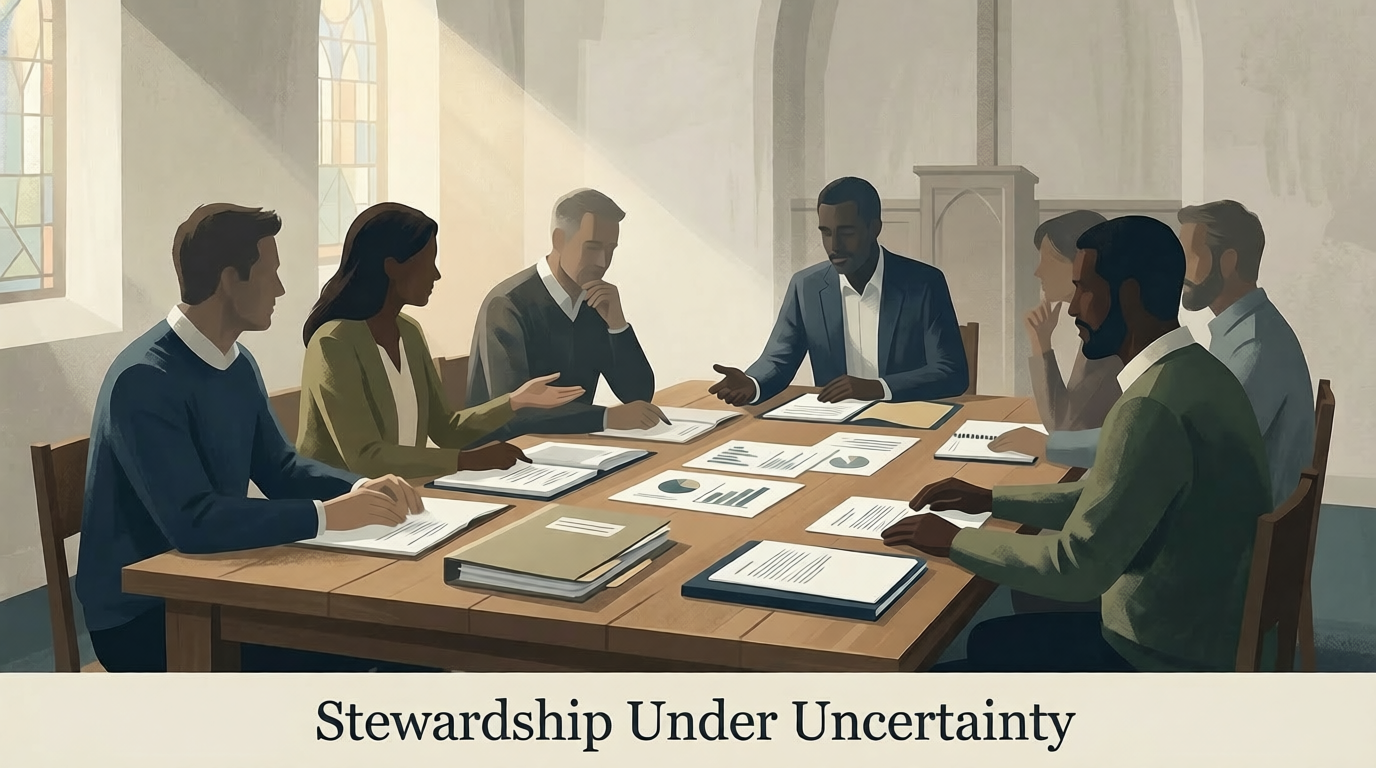 Urgency Used to Signal Leadership. Now It Signals Risk.
For many years, urgency carried moral weight in church leadership.
Moving quickly was often interpreted as decisiveness, faith, or confidence. Delays, by contrast, were viewed with suspicion — as hesitation, fear, or lack of alignment.
That framework is quietly breaking.
In 2026, many churches are choosing deliberation not because they lack conviction, but because uncertainty has changed the ethics of decision-making. When outcomes are harder to predict and consequences last longer, urgency loses its authority.
What replaces it is not paralysis.
What replaces it is stewardship.
The Shift Leaders Are Actually Making
This is not a shift from action to inaction.
It is a shift from speed-based leadership to process-based leadership.
Church leaders are increasingly asking different questions than they did before:
- Can this decision be defended later, not just justified now?
- Does this preserve flexibility if conditions change?
- Are we acting quickly, or acting carefully — and why?
Deliberation becomes a way of honoring responsibility rather than avoiding it.
Why Uncertainty Changes the Moral Equation
Uncertainty does more than complicate planning. It changes what leaders owe the people they serve.
When conditions are stable, urgency can be efficient.
When conditions are volatile, urgency can be reckless.
In uncertain environments:
- Information is incomplete
- Forecasts degrade faster
- Confidence can outpace evidence
Under those conditions, moving fast does not equal moving faithfully.
Deliberation becomes a form of ethical restraint.
Stewardship Reframed: From Outcomes to Process
A defining feature of this moment is how churches are redefining stewardship itself.
Stewardship is no longer described primarily in terms of:
- Growth
- Expansion
- Optimization
Instead, leaders increasingly describe stewardship as:
- Responsibility exercised through process
- Decisions made with transparency
- Accountability shared across governance structures
In this framing, how a decision is made matters as much as what decision is made.
This is not theoretical. It is operational.
The Governance Logic Behind Deliberation
Deliberation is not accidental. It emerges naturally when governance catches up to consequence.
1. More Voices, Fewer Shortcuts
Financial decisions now involve broader participation:
- Boards
- Committees
- Senior leadership teams
Each additional voice slows the process — but strengthens legitimacy.
Deliberation ensures that decisions are not merely efficient, but owned.
2. Reversibility Is Scarce
Many churches are recognizing that fewer decisions can be undone quietly.
Long-term commitments narrow future options. Leaders therefore spend more time examining:
- Second-order effects
- Exit constraints
- Reputational implications
Deliberation becomes a way of protecting future leaders from today’s haste.
3. Trust Has Become a Primary Asset
Internal trust — between leaders, boards, and congregations — is now understood as fragile and cumulative.
Once damaged, it is difficult to restore.
Deliberation slows decisions, but it:
- Preserves credibility
- Builds institutional memory
- Signals care rather than control
Urgency may satisfy the moment. Deliberation sustains the relationship.
What the Research Reflects
Listening-based research conducted with U.S. church leaders heading into 2026 shows this posture appearing repeatedly across roles and church contexts.
Leaders describe:
- Greater patience in sequencing decisions
- Increased emphasis on explanation and documentation
- Willingness to pause rather than force clarity
These patterns are summarized — without prediction or prescription — in the Church Finance Trends 2026 research hub.
The research does not suggest retreat.
It documents leadership adapting its tempo.
Why Deliberation Is Often Misread
From the outside, deliberation can appear passive.
From the inside, it is often intense:
- Multiple scenarios evaluated
- Assumptions challenged
- Risks surfaced explicitly
The misreading happens when observers equate leadership with motion rather than judgment.
Deliberation is not the absence of leadership.
It is leadership choosing discernment over display.
The Stewardship Lens That Makes Sense of This Moment
This shift aligns closely with how churches increasingly describe financial stewardship — not as technical expertise, but as moral responsibility exercised through governance.
Stewardship, in this sense, prioritizes:
- Integrity of process
- Clarity of rationale
- Preservation of trust
- Protection of future flexibility
Seen through this lens, deliberation is not delay.
It is care made visible.
The Risk of Reasserting Urgency
The real danger is not moving slowly.
The danger is reasserting urgency as a default virtue when conditions no longer support it.
That risk shows up when:
- Boards are pressured to approve prematurely
- Leaders are judged by pace rather than prudence
- Decisions are rushed to restore a sense of control
In those moments, urgency becomes a substitute for understanding.
A Clearer Interpretation of the Present
Churches are not abandoning action.
They are recalibrating tempo to match consequence.
Deliberation is the language leadership uses when:
- Outcomes are uncertain
- Accountability is shared
- Trust must be protected
This is not hesitation.
It is stewardship responding honestly to reality.
Closing Reflection
In 2026, the most responsible leaders are not always the fastest.
They are the ones willing to slow down — not to avoid action, but to ensure that when action comes, it is defensible, shared, and worthy of trust.
Authority Note
This article reflects listening-based insight developed through long-term exposure to church leadership and governance conversations, including research summarized by Griffin Church Loans. It is descriptive, not prescriptive.