
Gen Z Church Attendance Trends 2026: Implications for Church Growth

A Generational Shift — With Strategic Implications
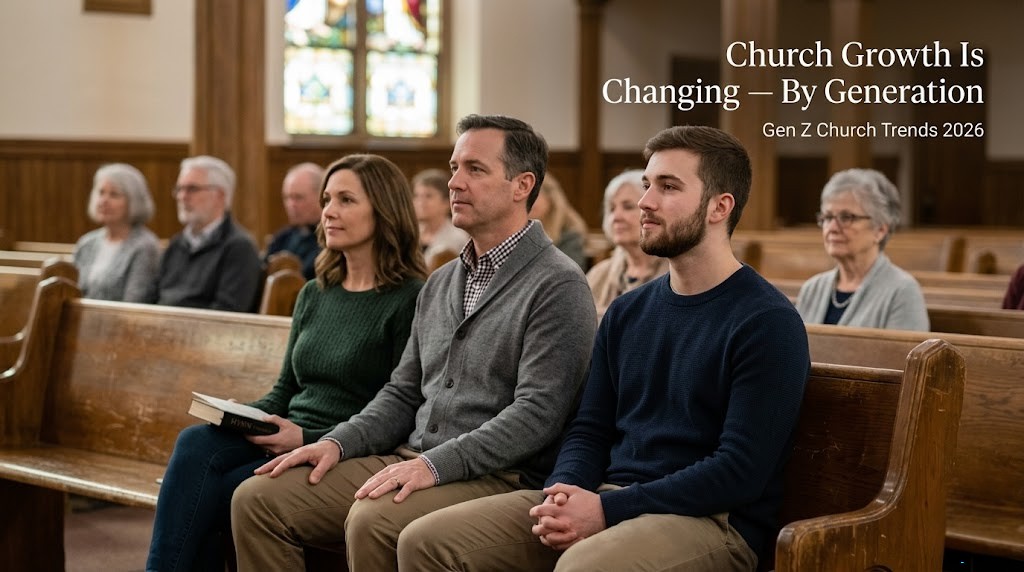
After nearly two decades of steady decline in church participation — with U.S. weekly attendance falling from the low-40% range in the early 2000s to the low-30% range pre-pandemic — new research suggests an unexpected development: among active attenders, Gen Z is increasing frequency of attendance — a key signal in emerging Gen Z church attendance trends 2026.
According to findings from Barna Group (September 2025), the typical Gen Z churchgoer now attends approximately 1.9 weekends per month — edging out Millennials and exceeding recent attendance rates of older generations. During the pandemic trough, younger adults averaged just over once per month. The current numbers represent a measurable rebound among committed participants.
Internationally, the Bible Society reports that church attendance among 18–24-year-olds in the UK rose from 4% in 2018 to 16% by 2024 — with young men showing particularly strong participation in several cohorts.
This does not represent a full-scale revival. Overall U.S. religious participation remains below early-2000s levels, and broader surveys from Pew Research Center continue to show high rates of religious unaffiliation among younger adults.
However, within the core of active church participants, engagement depth appears to be strengthening.
Because momentum without structure eventually creates long-term strain.
That distinction matters.
Churches navigating these shifts should align attendance patterns with broader church growth planning insights to avoid reactive decision-making.
Key Insights for Church Leaders
- Gen Z attendance frequency is increasing, particularly among already engaged participants
- Young men are returning at higher rates, reversing long-standing engagement patterns
- Growth is concentrated, not universal, indicating deeper but narrower participation
- Attendance growth does not equal financial growth, due to generational giving differences
- Sustained engagement — not short-term spikes — should guide expansion decisions
Gen Z Church Attendance Trends 2026: Key Statistics
To understand the magnitude of this shift, it helps to examine the data directly.
Recent research indicates increased attendance frequency among active Gen Z churchgoers compared to both pandemic lows and older generational cohorts. While national affiliation rates remain mixed, measurable engagement depth within committed segments is rising — particularly among young men.
The trend is concentrated rather than universal, but it is statistically meaningful among those already engaged.
The Return of Young Men: A Structural Reversal
Barna’s 2025 data indicates that men now report higher weekly attendance than women — the widest gender gap in 25 years of tracking.
For decades, women consistently outpaced men in religious engagement. A reversal of that pattern signals more than demographic fluctuation; it reflects cultural movement.
Young men appear to be seeking:
- Structure
- Community
- Identity clarity
- Mentorship
Churches that provide disciplined leadership, clear theological grounding, and relational accountability may continue to see sustained engagement in this segment.
Attendance frequency alone, however, is not a growth strategy.
Revival or Winnowing? Understanding the Concentrated Core
Some analysts suggest the apparent surge reflects a “winnowing effect”: less-committed individuals disengaged during and after the pandemic, leaving a smaller but more dedicated base.
Participation may be narrower — but deeper.
For church leaders, this shifts the conversation from raw attendance numbers to sustainability metrics.
Depth now outweighs breadth.
Church Growth Trends and Capital Planning in 2026
Demographic shifts influence more than Sunday seating. They affect facility utilization, giving patterns, leadership pipelines, and long-term capital exposure.
Sustained generational engagement — even at single-digit annual growth rates — can significantly alter space requirements and financial modeling over a 24-month period.
The question is not:
“Are we fuller this month?”
The question is:
“Is growth durable across economic cycles?”
1️⃣ Facility Utilization May Tighten Faster Than Expected
Even sustained single-digit annual growth can produce:
- Higher small-group demand
- Expanded youth and children’s ministry needs
- Multi-service scheduling strain
- Increased reliance on technology infrastructure
Many churches underestimate how quickly consistent growth compounds facility pressure.
2️⃣ Giving Patterns Will Shift — Not Always Proportionally
Gen Z tends to give:
- Digitally
- In recurring smaller increments
- Toward mission-aligned initiatives
- With strong transparency expectations
Attendance growth does not automatically translate into proportional revenue growth.
Before initiating expansion, leadership should evaluate:
- Donor age distribution
- Online giving penetration rates
- 24-month pledge consistency
- Debt coverage sensitivity under conservative attendance and giving projections
Churches considering capital expansion in a volatile rate environment must evaluate financing structures with long-term resilience — not short-term optimism.
Expansion decisions should be stress-tested against generational giving behavior, not current enthusiasm.
A disciplined church expansion financing strategy ensures growth decisions remain aligned with long-term financial health.
3️⃣ Leadership Infrastructure Determines Durability
Growth without leadership depth produces volatility.
Churches seeing increased engagement among younger adults should invest in:
- Mentorship structures
- Intergenerational discipleship
- Leadership development pathways
- Volunteer training systems
Sustained growth depends less on trend cycles and more on structured development.
A Financial Stewardship Perspective
From a capital planning standpoint, three indicators should precede major expansion.
These trends should be evaluated alongside structured church capital planning solutions that account for long-term sustainability.
The Griffin 3-Indicator Expansion Readiness Test
1. 24-Month Attendance Stability
Growth sustained across economic cycles, not seasonal spikes.
2. Generational Giving Stability
Consistent giving per household across age cohorts.
3. Engagement Depth Beyond Sunday
Small groups, volunteer participation, baptisms, and leadership development rising alongside attendance.
Temporary momentum does not justify long-term debt exposure.
Durable engagement does.
Churches that evaluate expansion through disciplined metrics reduce risk and increase long-term sustainability.
Frequently Asked Questions
Is Gen Z really returning to church?
Data from Barna and international studies indicates increased attendance frequency among active Gen Z participants, though broader religious affiliation trends remain mixed.
Why are young men attending more?
Research suggests many young men are seeking structure, accountability, and community amid broader cultural fragmentation. Churches offering clarity and disciplined leadership may be resonating.
Does increased attendance mean churches should build?
Not automatically. Expansion decisions should follow sustained engagement, stable giving patterns, and prudent financial modeling.
Is this a nationwide revival?
Current data suggests concentrated renewal among committed attenders rather than a full cultural reversal.
Strategic Leadership in a Transitional Moment
This demographic movement may represent early-stage renewal — or it may stabilize into a smaller but stronger core of believers.
Either way, wise leadership prepares deliberately.
Moments of momentum do not last indefinitely. Churches that steward growth with both spiritual conviction and disciplined financial strategy position themselves for long-term stability.
Discernment, data awareness, and structured capital planning will determine whether this generational shift becomes a lasting legacy or a missed opportunity.