Church Finance Trends 2026: What U.S. Church Leaders Are Preparing For | Griffin Church Loans

Church Finance Trends 2026

Griffin Editorial Team

Griffin Editorial Team

January 26, 2026

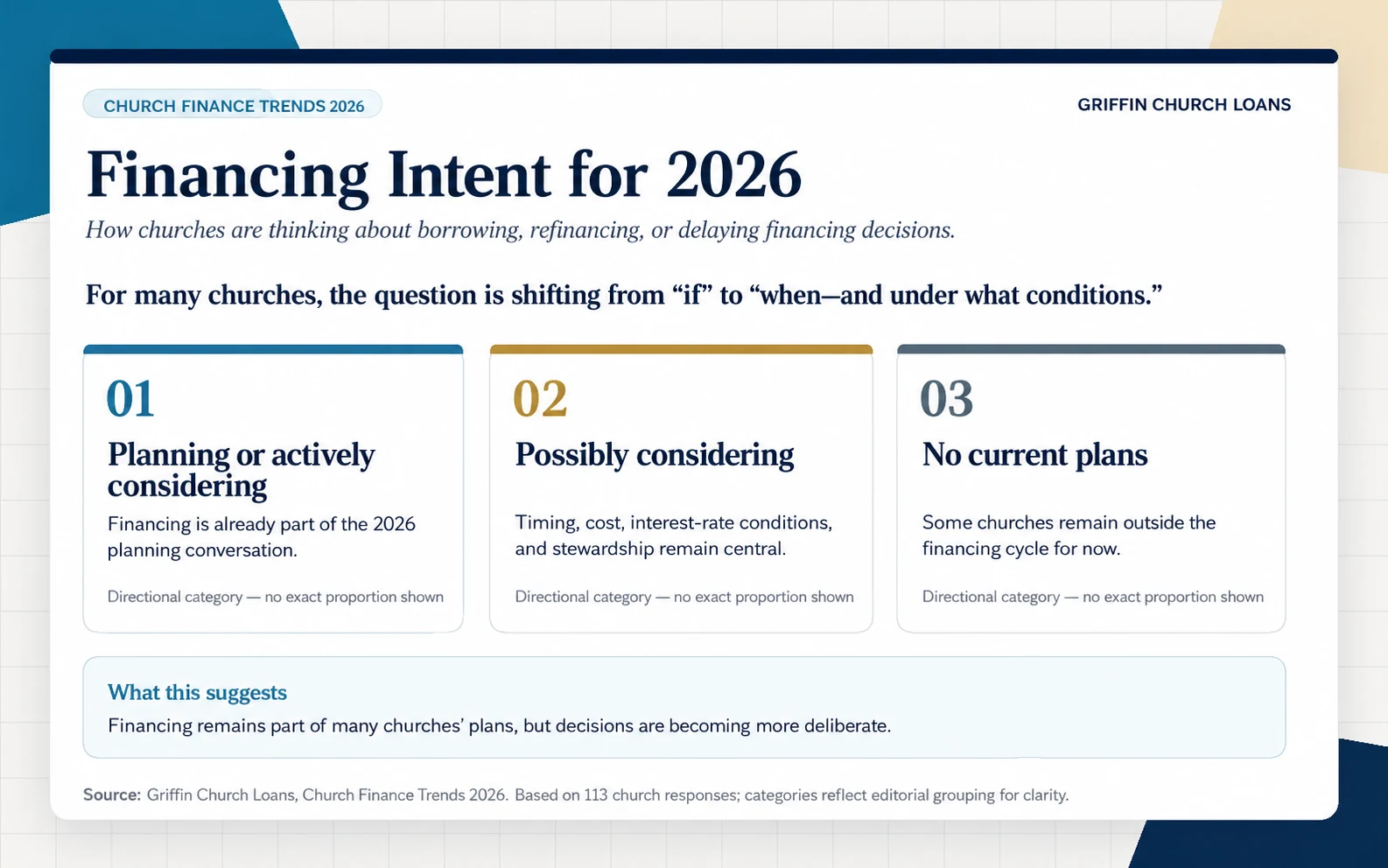
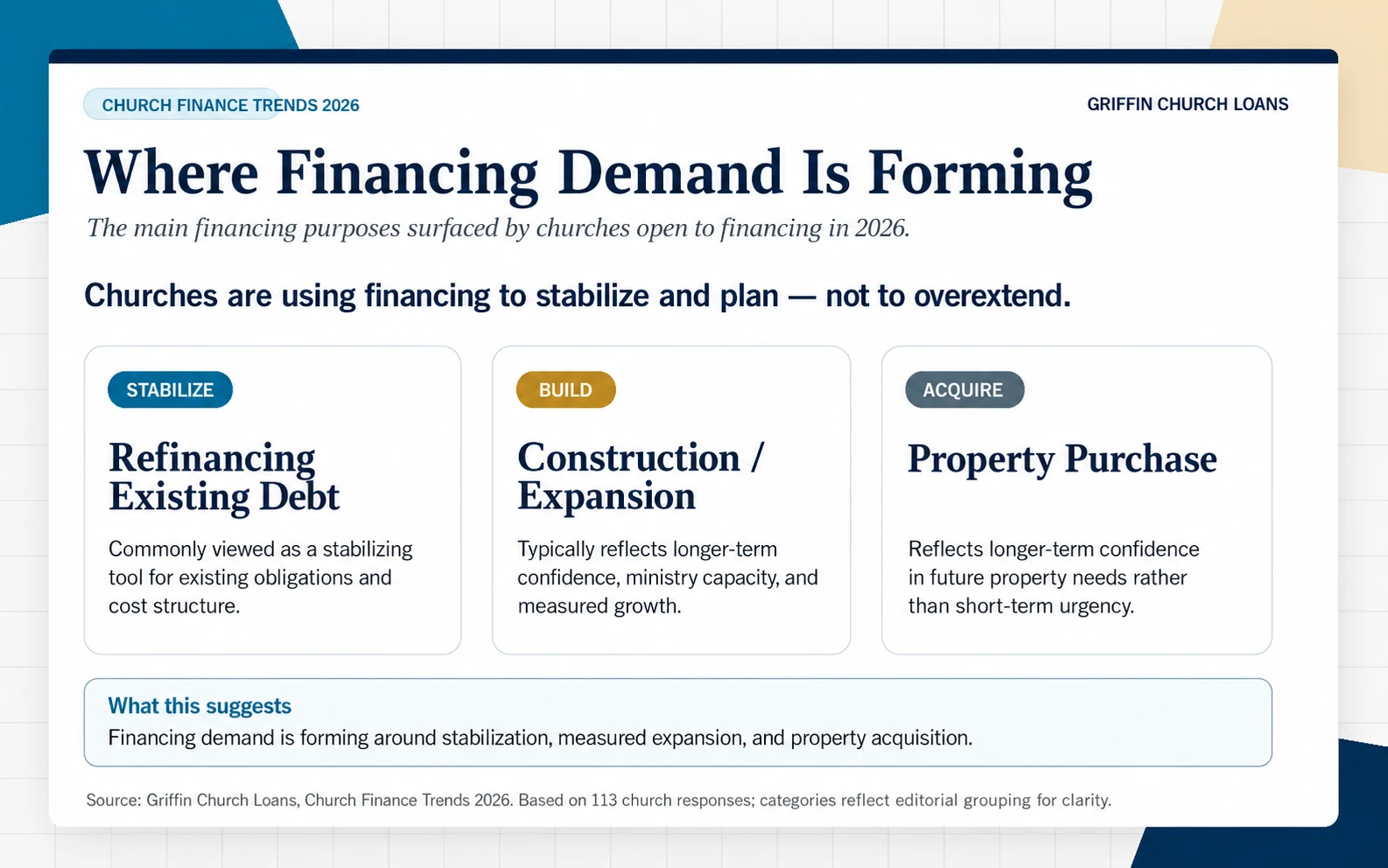
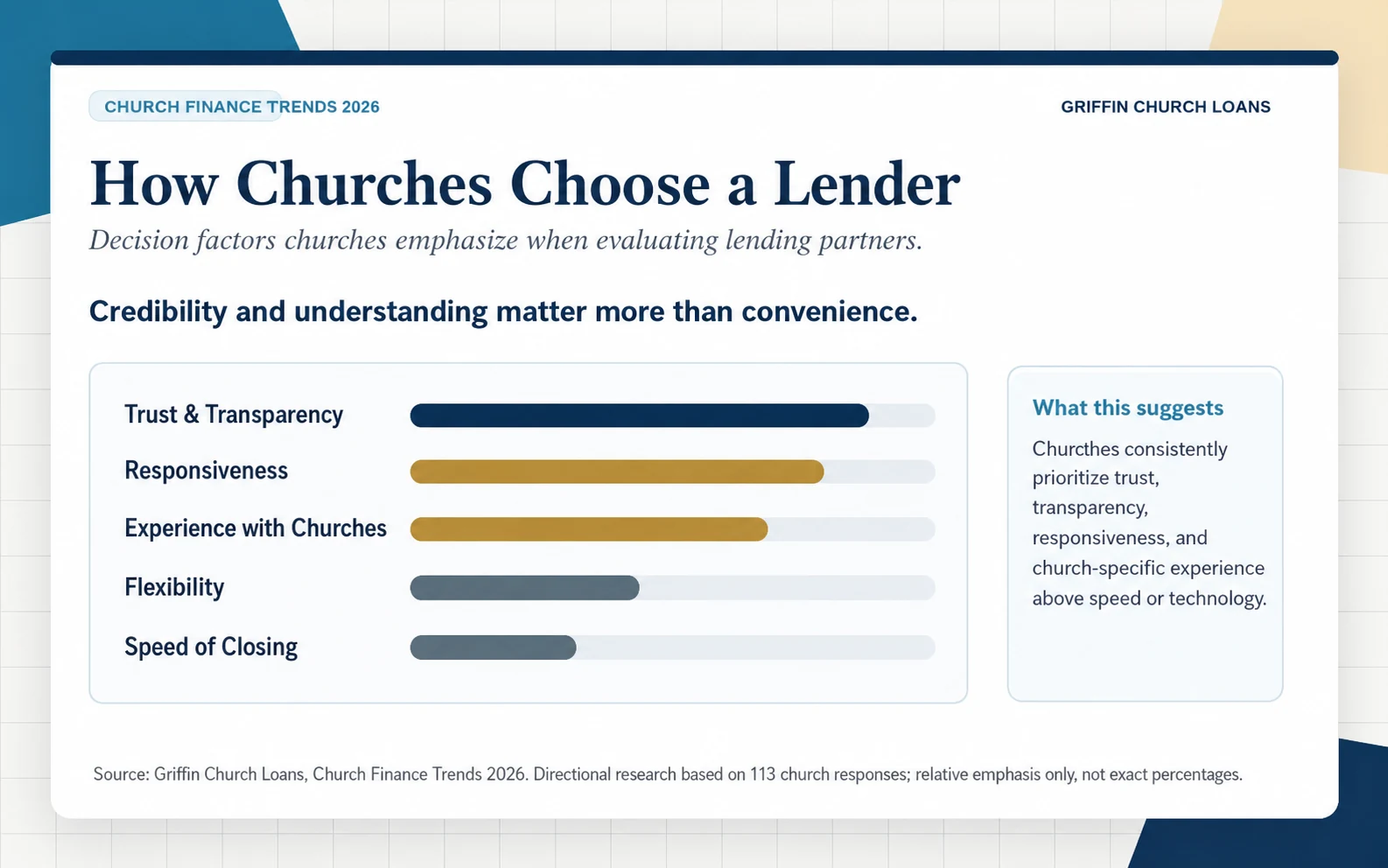
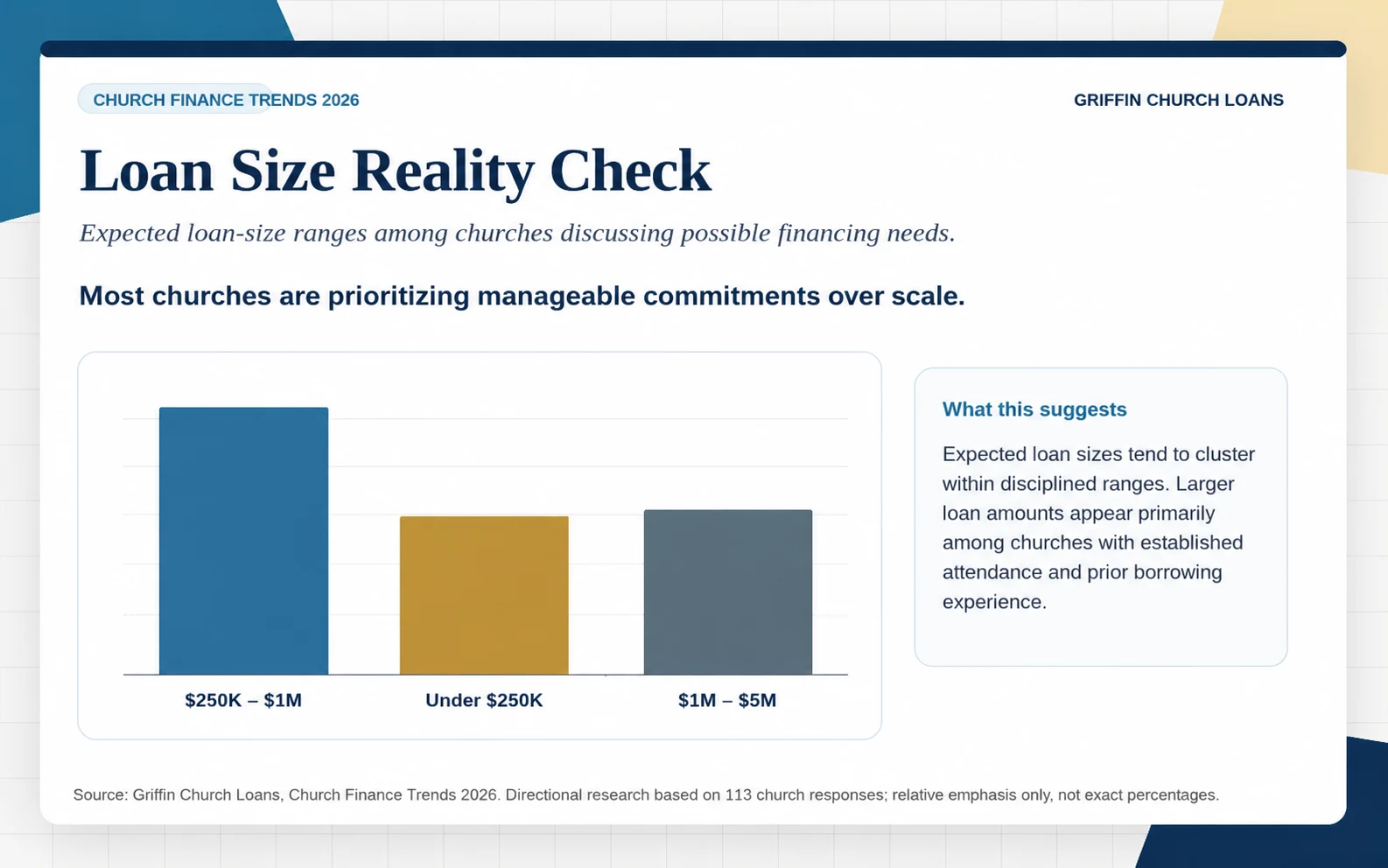
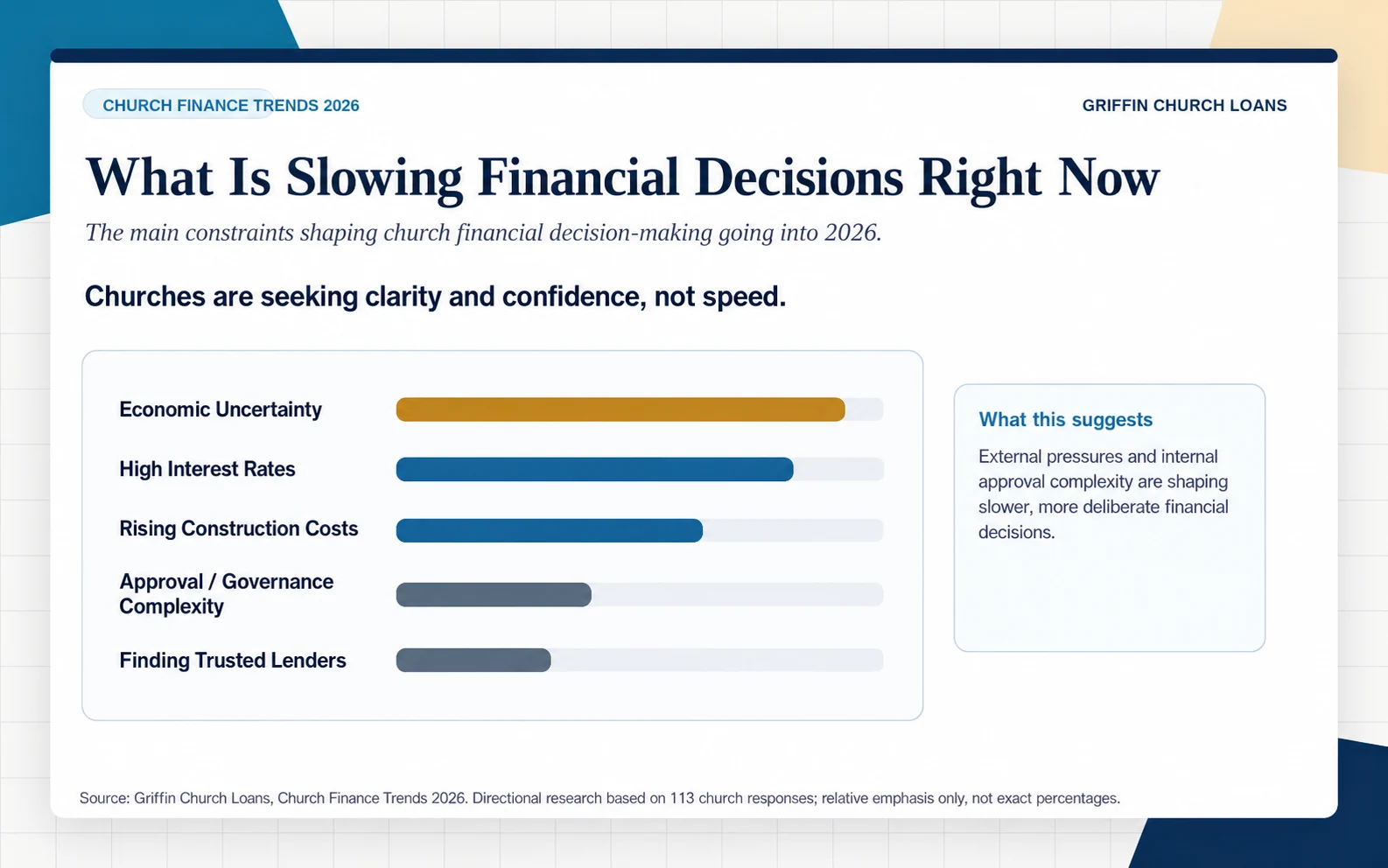
Alt text: Church finance trends 2026 survey results showing U.S. church leaders prioritizing caution and sustainability over expansion, based on directional research from 113 respondents by Griffin Church Loans

Above-the-Fold Editorial Introduction

Church finance is entering a more complex chapter in 2026—marked by economic uncertainty, shifting giving patterns, and growing operational pressure on leadership teams.

This research reflects the voices of 113 U.S.-based church leaders, offering a grounded view of how churches are thinking and planning for the year ahead. Rather than forecasting outcomes, it documents what leaders are actually experiencing—and how they are responding.

Purpose: to provide clarity, not prediction.

Download the full Church Finance Trends 2026 report — with detailed charts, role-based breakdowns, and contextual interpretation notes.

Download the Full Report (PDF)

Why This Research Was Conducted

The year ahead presents challenges that are not purely financial.

Church leaders are navigating:

  • Lingering economic pressure on congregations
  • Rising operating and facility costs
  • Increased scrutiny around financial stewardship
  • Decision fatigue at the board and senior leadership level

In this environment, speculation is easy—and often misleading.

This research was conducted because listening is more responsible than guessing. Instead of projecting assumptions onto churches, this effort focused on capturing how pastors, treasurers, and boards are thinking in real time.

Churches are not uniform. Their voices deserve to be heard as they are—not simplified, optimized, or reframed for narrative convenience.

Research Method (Brief & Transparent)

  • Respondents: 113 U.S. church leaders
  • Roles represented: Senior pastors, executive pastors, finance committee members, treasurers, and board leaders
  • Timing: Conducted in late 2025
  • Method: Anonymous survey

Important note:
This research is descriptive, not predictive. It reflects reported perspectives at a moment in time and should be read as directional insight—not financial advice or universal truth.

Core Insights from Church Leaders

The following themes emerged consistently across responses from 113 U.S. church leaders surveyed in late 2025.

1. Caution Is Replacing Expansion

Many leaders report a measurable shift away from aggressive growth planning toward more conservative, sustainability-focused decision-making. Churches that were actively exploring new facilities, additional campuses, or large capital projects in prior years describe pausing or scaling back those plans. This does not reflect pessimism — it reflects a deliberate recalibration toward protecting financial health before pursuing growth. For many congregations, the priority has moved from “what can we build?” to “what can we sustain?” Leaders describe this shift as responsible, not reactive.

2. Financial Confidence Varies Widely

The survey revealed no single financial mood across U.S. churches. Some congregations report relative stability, with consistent giving and manageable operating costs. Others describe growing concern around cash flow unpredictability, shrinking reserves, and uncertainty about whether current giving levels will hold through 2026. This variation matters because it means there is no universal church-finance forecast — and any content or advice that treats churches as a monolith will miss the mark. Leaders navigating tighter margins are making fundamentally different decisions than those operating with a cushion.

3. Boards Are More Involved Than Before

Financial decisions are increasingly shared across leadership teams rather than concentrated in a single pastor or administrator. Board members, finance committees, and treasurers report being pulled into conversations earlier and more frequently — particularly around debt, capital expenditures, and reserve policies. This trend suggests a healthy maturation in church governance, but it also introduces complexity. More voices in the room means longer decision timelines, more documentation needs, and a greater emphasis on financial literacy at the leadership level.

4. Stewardship Language Is Becoming Central

Leaders are placing renewed emphasis on responsibility, transparency, and restraint — both in internal decision-making and in how they communicate financial matters to their congregations. The word “stewardship” appeared repeatedly across open-ended responses, often tied to a desire to demonstrate that leadership is handling resources carefully. This is more than branding. Churches that lead with stewardship-first language are positioning financial decisions as acts of faithfulness, not just operational necessity. That framing shapes borrowing conversations, capital campaign messaging, and how congregations evaluate their leadership’s credibility.

5. Uncertainty Is Driving Deliberation

Rather than urgency, many churches describe slower decision cycles, longer board discussions, and a clear preference for reversible commitments over irreversible ones. Leaders are asking more questions before acting, seeking more external input, and in some cases choosing to defer decisions rather than risk a mistake under pressure. This deliberation is not inaction — it is a strategic posture. Churches that slow down in uncertain environments tend to make better long-term financial decisions, even if it means short-term delays in projects or initiatives they care about.

These insights are not signals of weakness. They reflect prudence under complexity.

How to Read the Full Report

This report is designed to:

  • Surface patterns in church financial thinking
  • Support leadership conversations
  • Encourage thoughtful planning

It is not intended to:

  • Predict economic outcomes
  • Recommend specific financial actions
  • Rank or evaluate churches

Leaders are encouraged to use this research as a conversation tool, not a decision substitute.

Frequently Asked Questions About Church Finance in 2026

What are the biggest financial challenges facing churches in 2026?

Based on responses from 113 U.S. church leaders, the most commonly cited challenges include economic uncertainty affecting congregational giving, rising facility and operating costs, cash flow unpredictability, and increased pressure on leadership teams to demonstrate financial stewardship. These challenges are not uniform — they vary significantly by congregation size, region, and financial reserves.

Are churches spending more cautiously in 2026?

Yes. A clear theme across the survey was a shift from expansion-oriented planning toward sustainability-focused decision-making. Many leaders describe pausing or scaling back capital projects, prioritizing reserves, and taking longer to evaluate financial commitments before acting.

How are church boards changing their approach to financial decisions?

Church boards and finance committees are taking a more active role in financial oversight than in prior years. Leaders report that boards are involved earlier in decision-making, asking for more documentation, and placing greater emphasis on long-term financial planning rather than approving decisions reactively.

What does “stewardship-first” mean in church finance?

Stewardship-first is a posture that frames financial decisions as acts of responsibility and faithfulness rather than purely operational choices. Churches adopting this language are emphasizing transparency, restraint, and careful resource management — both internally and in communication with their congregations.

Why are church financial decisions taking longer right now?

Many churches report that uncertainty — around the economy, giving trends, and operating costs — is driving longer deliberation cycles. Leaders are asking more questions, seeking outside counsel, and preferring reversible commitments over irreversible ones. This is generally a sign of prudence, not paralysis.

Is this survey predictive of what will happen in church finance?

No. This research is descriptive, not predictive. It captures what 113 church leaders were experiencing and planning for at a specific moment in late 2025. It should be read as directional insight to support leadership conversations — not as a forecast or financial recommendation.

How can churches use this research?

This report is designed as a conversation tool for church leadership teams. It can help boards benchmark their own concerns against broader trends, frame financial planning discussions, and identify areas where additional attention or outside expertise may be valuable.

Full Report Access

The complete Church Finance Trends 2026 report provides:

  • Detailed charts and distributions
  • Role-based response breakdowns
  • Contextual interpretation notes

The full research report is available here.

Church Finance Trends 2026 Survey Report

Related Insight Articles

For additional context, the following editorials explore specific dimensions of the findings:

For a practical guide to financing choices, see how to finance a church.

About Griffin Church Loans

Griffin Church Loans has worked alongside churches for over 26 years, supporting leadership teams through periods of growth, transition, and uncertainty.

This research reflects a stewardship-first posture: listening carefully, documenting responsibly, and contributing insight without pressure or agenda.

This research was conducted by Griffin Church Loans as part of its ongoing effort to listen to and learn from church leaders nationwide.

Griffin Editorial Team

Author Spotlight

Griffin Editorial Team

The Griffin Editorial Team produces leadership-level editorial and research-context content focused on church finance, governance, and long-term stewardship.

Content published under the Griffin Editorial Team reflects an institutional perspective informed by long-term engagement with church leaders across diverse denominational, organizational, and economic contexts.

The team’s work is explanatory and contextual in nature, intended to support understanding and dialogue. It does not provide financial advice, recommendations, or prescriptive guidance, and is maintained to meet high standards of editorial neutrality, clarity, and responsibility.